Sunday, September 7, 2014

The 1883 “Racketeer” Nickel
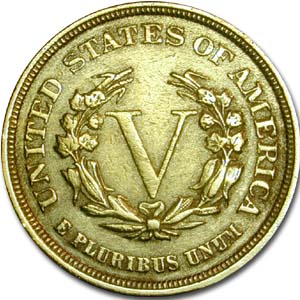
The 1883 “Racketeer” Nickel


The 1883 “Racketeer” Nickel In 1883 the Mint issued a new 5c coin with the head of Liberty and a Roman “V” meaning “5″ on the reverse. Many people thought that the coin was an error since in didn’t have “cents” anywhere on the coin.

The lack of the word cents created an opportunity for the unscrupulous. The coins were gold plated and reeds were cut into the edge by hand (nickels have a plain edge) and they were passed off as $5 gold coins.1883-racketeer-nickel

The most famous criminal case about altered 5 cent coins involved a deaf mute named Josh Tatum. He would go to cigar stands and purchase a 5c cigar and pay with a gold plated, hand reeded nickel. The attendant would assume that it was a $5 gold piece and give Josh $4.95 change. He was acquitted since he never said that the coin was $5, he couldn’t. The Mint learned its lesson and later that year put the word “cents” at the bottom of the reverse.

Some of these “Racketeer” nickels survive today and are interesting to collectors. Over the last century, there are many nickels that have been gilt and passed off as the “real” thing so beware of “copies”. Its not easy to ascertain whether you have a “genuine” racketeer nickel as they are all altered coins tampered with outside the Mint. Generally, the ones used in 1883 have some or all of the gilt rubbed off and have a very carefully reeded edge.


This information is complied/referenced data from around the web. Linked references within.
COIN TYPE DESCRIPTION
Years Minted:1883-1913
Mint Marks:NONE (P), D, S
Denomination:5C
Obverse Design:Liberty, wearing a coronet and wreath
Obverse Designer:CHARLES BARBER
Reverse Design:Roman numeral V, for 5, indicating the denomination, surrounded by a wreath
Reverse Designer:CHARLES BARBER
The Liberty Head nickel, sometimes referred to as the V nickel because of its reverse (or tails) design, is an American five-cent piece. It was struck for circulation from 1883 until 1912, with at least five pieces being surreptitiously struck dated 1913.

The original copper–nickel five-cent piece, the Shield nickel, had longstanding production problems, and in the early 1880s, the United States Mint was looking to replace it. Mint Chief Engraver Charles Barber was instructed to prepare designs for proposed one-, three-, and five-cent pieces, which were to bear similar designs. Only the new five-cent piece was approved, and went into production in 1883. For almost thirty years large quantities of coin of this design were produced to meet commercial demand, especially as coin-operated machines became increasingly popular.

Beginning in 1911, the Mint began work to replace the Liberty head design, and a new design, which became known as the Buffalo nickel, went into production in February 1913. Although no 1913 Liberty head nickels were officially struck, five are known to exist. While it is uncertain how these pieces originated, they have come to be among the most expensive coins in the world, with one selling in 2010 for $3,737,500.


History courtesy of Liberty Coin Collector Society
**
Chester Alan Arthur was in the White House, and Franklin Delano Roosevelt was napping in a nursery in Hyde Park, New York. FDR, after all, was only one year old at the time. Horse-drawn carriages ruled the roads and in New York City, they also reigned supreme on the just-completed Brooklyn Bridge.

The year was 1883, and one year after FDR's arrival in that nursery, the United States Mint was busy giving birth to a "baby" of its own: the Liberty Head five-cent piece.

The father of the new coin was A. Loudon Snowden, Superintendent of the Philadelphia Mint. Snowden believed that the nation's three minor coins, the cent, three-cent piece and five-cent piece, should be uniform in design and metallic composition. In 1881 he directed Chief Engraver Charles E. Barber to prepare suitable sketches for these denominations, with all three to feature a classical head of Liberty.

Barber completed the task late that year, and trial strikes were made of the three coins. All were very simple in design, with the Liberty head on the obverse and a Roman numeralI, III or Von the reverse within a wreath, signifying values of one, three and five cents, respectively. All were struck in copper-nickel, the same alloy being used already in the three-cent piece and the Shield nickel.

It soon became apparent that Congress would oppose a change in composition for the cent, which was made of bronze. Furthermore, the Treasury would not permit a design change for the three-cent piece. That left only the five-cent piece, and Snowden and Barber concentrated on overhauling it.

The Shield nickel, introduced in 1866, was the first base-metal five-cent piece in U.S. history; up to then, the half dime, a small silver coin, had filled the nation's need for that denomination. Though reasonably well accepted, the Shield nickel was hardly untouchable; its stark, bland design made it a prime candidate for remodeling. And its newness didn't protect it from replacement: At that time, there wasn't yet a federal law establishing a minimum life expectancy for U.S. coin designs.

Snowden admired Barber's new design, and he also welcomed the change because it gave him a chance to increase the diameter (and thus reduce the thickness) of the nickel. He believed that this would lengthen die life dramatically. Snowden proudly unveiled the Liberty Head nickel at a special ceremony on Jan. 30, 1883. Dignitaries attended and souvenirs of the first strikes were distributed to the guests. Regular coinage began later that weekthen suddenly, the celebrating stopped.

The first "V nickels" had barely left the Mint when appalled officials found a fundamental flaw in their design: Barber had omitted the word CENTS. His oversight soon created a crisis for Uncle Sam: Confidence artists were plating the nickels with gold and passing them off to unsuspecting merchants as $5 gold pieces. They were, after all, virtually the same size as half eagles. As brand new coins, they were still unfamiliar to the public, and they lacked any statement of value beyond the letter V, which, of course, could represent either five cents or five dollars.

Barber quickly prepared a new design, this time placing CENTS in big, bold letters below the V. By then, however, the Mint had struck nearly 5 1/2 million of the so-called "Type 1" nickels, and many had been gold-plated and passed. Even today, it isn't uncommon to find these "racketeer nickels" in hoards and collections. Their value as collector's items is small, but they hold great appeal as historical curiosities. By the end of 1883, the Mint had produced more than 16 million nickels with CENTS on the reverse, but the "no CENTS" variety is far more common today in choice condition. Many people set examples aside, mistakenly believing that having been replaced, these would someday be rare.

Following all the drama surrounding its introduction, the Liberty Head nickel settled down to a sedate existence and one more befitting its role as a coin of the realm in the late Victorian era. There were no further changes in its simple, straightforward design, and for all but the final year, there were no branch-mint issues to complicate matters, either; the Philadelphia Mint produced the entire mintage except in 1912, when Denver and San Francisco struck the coin as well in its last official appearance. (The mint mark appears to the left of the word CENTS on the reverse).

There are low-mintage issuesnotably 1885, 1886 and 1912-Sbut there are no great rarities; 1912-S, at 238,000, is the only coin with a mintage below a million. At the other extreme, not one V nickel topped the 40-million mark; 1911 is the highest with just over 39.5 million.

In 1913, the Liberty Head design gave way to the Buffalo type. No Liberty nickels were made that year officially, but years later collectors were stunned to learn that five 1913 examples had surfaced, all of them apparently made on the sly by someone at the Philadelphia Mint. Despite their clouded origins, these came to be accepted as legitimate collectibles, and they now rank among the most coveted and valuable of all U.S. coins.

Although it covers 30 years, the Liberty nickel series makes for a compact and completeable set, largely because of the all-but-total lack of branch-mint issues. For that reason, it's widely collected by date and mint, though many do collect it simply by type. Proofs were made in every year, always in the thousands, a high level for that period.

Because of their low relief, V nickels are generally well struck and are readily available in very high grades. Points to check for wear are the hair above Liberty's ear and the wreath and corn ears on the reverse.

Controversy marked both the birth and the demise of the Liberty Head nickel. There's no disputing one thing, though: This is a coin with exceptional appeal for collectors.
**


REF: Wiki 'no marks'
REF**: Liberty Head Nickel Collector Society

NOTE:
If your looking for more information
Liberty Head Nickel Collector Society
has a great collection of data.

**
Some of this historical information is provided complements of NGC (Numismatic Guarantee Corporation). NGC is the "grading service of choice" of the ANA (American Numismatic Association), the largest collector oriented organization in the United States. NGC is one of the two largest independent grading services. NGC has been grading coins since 1987, and have graded in excess of two and one half million coins.


Year & Mint Mintage Proof Mintage
1883 No CENTS 5,474,300 5,219
1883 With CENTS 16,026,200 6,783
Year Mintage Proof Mintage
1884 11,270,000 * 3,942
1885 1,473,300 * 3,790
1886 3,326,000 * 4,290
1887 15,260,692 * 2,960
1888 10,715,901 * 4,582
1889 15,878,025 * 3,336
1890 16,256,532 * 2,740
1891 16,832,000 * 2,350
1892 11,696,897 * 2,745
1893 13,368,000 * 2,195
1894 5,410,500 * 2,632
1895 9,977,822 * 2,062
1896 8,841,048 * 1,862
1897 20,426,797 * 1,938
1898 12,530,292 * 1,795
1899 26,027,000 * 2,031
1900 27,253,733 * 2,262
1901 26,478,228 * 1,985
1902 31,487,581 * 2,018
1903 28,004,930 * 1,790
1904 21,403,167 * 1,817
1905 29,825,124 * 2,152
1906 38,612,000 * 1,725
1907 39,213,325 * 1,475
1908 22,684,557 * 1,620
1909 11,585,763 * 4,763
1910 30,166,948 * 2,405
1911 39,557,639 * 1,733
1912 26,234,569 * 2,145
1912-D 8,474,000 * 0
1912-S 238,000 * 0
1913 0 * 5 known
Word Count: 1372 - 

Wednesday, August 20, 2014

George Klauba Obverse Designer of the 1995 WWII 50th Annv. Half Dollar


George Klauba 
Obverse Designer of the
1995 WWII Commemorative Clad Half Dollar  
92% copper  - 8% nickel - diameter 1.205

In 1991, my design was chosen for the obverse side of a new half dollar commemorative coin produced from 1991-95, by the United States Mint to honor the fiftieth anniversary World War II, "in accordance with legislation passed by Congress and signed by the President on October 14, 1992." (Image copyrighted by the artist. © George Klauba. All rights reserved.) The design represents three military personnel superimposed on a V for victory with a B-29, the plane ended the war with Japan. The five stars represent the five branches of military service. ~ George Klauba Website


.

Friday, August 8, 2014

Coins of New Zealand


Coins of New Zealand
Source: coins.obscurefinds.com

New Zealand is located in the southwest Pacific Ocean. This country has two main landmasses, the North Island and the South Island. Because of its coldness, it was settled the last land by people.

An explorer saw this country and he called it a Staten Landt, assuming that it is connected to the continent of its same name in the southern slope of another country. After the Dutch province, it was renamed again by the mapmakers as Nova Zeelandia. But the British explorers altered the name to New Zealand.

The monarchy of New Zealand was defined as the crown in the right of their country. This right is the legitimate system of their government which is the transmissible monarch is the independent and New Zealand head of state that forms the central of the nations’ democracy.

Kowhai is a native flower of New Zealand its name comes from Maori, their word for yellow, referring to the color of the flower. In some areas, it is called kohai. It is also the national flower of New Zealand.

New Zealand is separated into twenty five terrestrial regions, and each of them has their physical qualities, various nation, antiquity, and sole points of curiosity. Form its substitute tropical remote polar you can stand on the tilt of its north island to observe the integration of two seas, to the bottom of south islands. The last continent before the frost drops of Antarctica, each in New Zealand region has separate personality and stories.

Several states in the whole world can display New Zealand series of natural geographies from a high speaks in the massive mountain arrays to substitute tropical forests, rich systematic countryside to geothermal movement, the black and white sand seashore to wasteland as unpopulated islands and grasslands. For thousands of years, the governor of New Zealand protracted some British laws to New Zealand. It means that the definite unit of the grand coinage became applicable to the new society. This British coin is allowing the typical silver, gold, and bronze to mix easily in New Zealand together with the current variety of overseas coins. These coins are made lawfully affectionate in relations of some act by the transient of acts. Before, there was a risky lack of coins, specifically copper coins. Dealers tried to cure the issue of a low prices paper record, but this was presently discarded. In its place of this shortage strengthened thru the years, commercial in the other country decide to this matter their major copper tokens. In all traders or retailers deliver their own money and half tokens. This preparation survived for a year with their use slowly decreasing.

Previously it’s understandable that somewhat had to be completed around the coin trafficking and the scarcity of lower values of coins in New Zealand. It was sure that the New Zealand must start distributing coinage from a bank. New Zealand Numismatic culture proposed that the New Zealand must adopt a number system of money. On the other hand a unique coinage of New Zealand was presented based on a decimal system.

The New Zealand currency happened over the year when New Zealand strike was substituted by the dollar ranging of one pound into two dollars. On the similar day there are new decimals coin are presented to substitute on the current pound coins. The first coin in New Zealand is: one cent, two cent, five cent, ten cent, and fifty cent. One cent, two cent and fifty cent are the new sizes, 1c and 2c are minted in bronze, 50c in cupronickel. 5c, 10c, and 20c are same size, same weight, and same value as their former sixpence, florin, and shilling coins. In fact, the 10 cents accepted as additional to legend. The front design of all coins is featured in a portrait of Elizabeth II. Numerous designs are finally accepted for maximum coins. Another design of coin in New Zealand was the fern coin it is an ionice symbol and it is recognized in the whole world.

New Zealand officials are honoured to be the only issuer of authorized collection of coins with partnership with the bank of New Zealand. They work with highly cherished mints from all in the world to create a high standard memorial coin, the coinage they issue are the legal of New Zealand tender and that was the features portrait of Queen Elizabeth II and the opposite face. The coins that comes from New Zealand was reflect piece of the uniqueness and their traditional identity. New Zealand has distributed valuable and non-valuable commemorative money collections. New Zealand coins celebrated their heroes, recognises the dilemma of their rare species, platform their breath taking land and they honour its greatest adored bird and the kiwi. They collect their coins because they are securing an exclusive piece in their homeland.

New Zealand has issued two kinds of coins brilliant uncirculated ad proof quality. The first one is made from a mixture of non-valuable materials it is produced with a shiny surface. Brilliant Uncirculated coins are aluminium bronze while Proof quality coins are the highest quality coin produced in a snowy finish and reflected background. These coins are hit more than one with Medias functioning at slow hustles with high remarkable weight, to make a coin with severe detail. Their proof coins are discovered from valuable metals with 24 carat bullion. An great example would be the Donald Duck coins 2014-80th Anniversary of Donald Duck Gold/Silver Coins.

Nowadays, New Zealand has a modern, wealthy and industrialized market with an assessed major native product. Their money is the New Zealand dollar also known as kiwi dollar they are likewise socialized in Cook Islands. This country was classified as number 16 last year. Traditionally, extractive trades have strongly donated to economy of New Zealand it will focus in various times on finalizing, flax, whaling, kauri gum, gold and natural woods. New Zealand achieves their higher living by the help of the other country. They became dependent on global trade mostly in agricultural goods.

New Zealand Culture they reformed the east culture with the trials related with a large and assorted environment, developing their culture. The large country life in first New Zealand runs to the image of their country being rough, productive problem solvers. Glad to say that New Zealand is a progressive country in the world.


.

Saint-Maurice Ironworks Silver Dollar


1988 - Elizabeth II - Saint-Maurice Ironworks 


250th anniversary of the first industrial refinery in Canada 
Source: coinhistory.info 

A Royal proclamation specifies the design of the 1988 $1 silver coin and the $1 bronze-plated nickel coin. The silver dollar commemorates the 250th anniversary of the first industrial refinery in Canada, the Saint-Maurice Ironworks. The nickel dollar continues the loon design. [455.1081] 

REF 


Commemorative Silver Dollar 
Source: en.wikipedia.org 
Year 1988 
Theme Saint-Maurice Ironworks 
Artist R.R. Carmichael 
Mintage (Proof) 259,230 
Issue Price (Proof) $20.00 
Mintage (BU) 106,702 
Issue Price (BU) $15.00 

REF


Saint-Maurice Ironworks 
Source: en.wikipedia.org 

Forges du Saint-Maurice ("St. Maurice Ironworks"), just outside of Trois-Rivières, Quebec, is a National Historic Site of Canada, and birthplace of the country's iron industry. 

Forges du Saint-Maurice was created on 25 March 1730, the second company (after the failure of the first) granted a monopoly to employ the iron ore deposits at Trois-Rivières. 

The forge started working in 1738 and remained in virtually continuous operation until closing. It employed about 100 craftsmen (most originally from Burgundy) and 300-400 labourers in production of forged and molded iron products, including pots, pans, and stoves. Director F. E. Cugnet went bankrupt in 1742, leading to a state takeover and handover to Britain after the Treaty of Paris. 

In 1747, the company experimented unsuccessfully with cannon making and steel production. From 1738 into the mid-1830s, the Forges were "the most technologically advanced ironworks in America", but had become the oldest operating blast furnace in North America, and far out of date, by the time it shut down for good in March 1883. 

In 1973, Forges du Saint-Maurice became a national historic park. Archaeological research there continues. 

REF


VIEW A


.

Wednesday, August 6, 2014

Tunisia Olive Tree Coin Reverse

tunisia_olivetree.png

Olive tree on the back of Tunisia coin's.

Olive tree as found on the 1, 2 and 5 Millim coins of Tunisia. The olive tree is a symbol of Tunisian agriculture. The image was made from an image of a coin. [3]

Olive Growing In Tunisia

Tunisia is the most important olive-growing country of the southern Mediterranean region; over 30% of its cultivated land is dedicated to olive growing (1.68 million ha). Tunisia’s olive resources are estimated at over 65 million olive trees, grown on 1 680 000 ha, of which 75 000 ha are for certified organic crops. It is a source of employment for 269 000 or 57% of the country’s farmers and accounts for 45% of the agricultural exports, averaging 120 000 t per year. At a world level Tunisia is ranked fourth in terms of the number of olive trees and second in terms of acreage. [1]

Tunisia is one of the world's largest olive oil producers. Olive oil production plays a key role in the Mediterranean country's economy, employing more than 300,000 farmers and providing some sort of income to an estimated one million Tunisians. [2]

Top Exports - Tunisia - 2011 [4]

Commodity: Olive oil, virgin
Quantity: 100,294(tones)
Value: 285,866(1000 $)
Unit value: 2,850($/tonne)


Sources:
REF[1]sarrahuiles.com.tn
REF[2]cnn.com
REF[3]wbcc.fsnet.co.uk
REF[4]aostat.fao.org
Related To: 

Tunisia - 5 Millimes
Tunisia


SEE A


.

Tuesday, August 5, 2014

1999-2000 - Elizabeth II - Millennium Quarter

1999-2000 - Elizabeth II - Millennium Quarter 

In April 1998, the Mint announced the Millennium Coin Design Contest, a contest open to all Canadians to submit designs for twenty-four millennium quarters, one for each month of 1999 and 2000. The 1999 designs were meant to look back on Canada's past, while the 2000 designs looked to the future. While the 1999 coins were labeled with their month of issue, the 2000 coins were labeled with the relevant theme. Obscure Finds Coin collection OFCC has documented this set of coins see below for link or see the entire set by clicking here. 


Canada: 1999-2000 Millennium 25 Cent Series 
Source: typesets.wikidot.com 

To celebrate the new millennium, Canada created a two year circulating commemorative program that would be conducted in two parts (one in 1999 and one in 2000). Each program released 12 quarters per year ( 1 per month) and each featured a unique design. The 1999 plan featured designs representative of Canada's past. In an open design contest called “Create a Centsation” over 33,000 designs were submitted for consideration. The 2000 plan featured designs representative of Canada's dreams for a new millennium. A second design contest was held and over 66,000 designs were submitted for consideration. 

1999 - January - A Country Unfolds - Mintage: 12,181,200 
When put together the four images in this coin form the year 1999 

1999 - February - Etched in Stone - Mintage: 14,469,250 
Design features native petroglyphs that capture the historical heritage & spirituality of Canada 

1999 - March - The Log Drive - Mintage: 15,033,500 
Historical reference of Canadian raftsmen and the significant contribution they made to the growth and prosperity of Canada 

 Design features Inuit art 1999 - May - The Voyagers - Mintage: 15,566,100 Homage to the explorers & pioneers that mapped the new lands and created the fur trade 

1999 - June - From Coast to Coast - Mintage: 20,432,750 
Celebrates the historic Pacific Railway that connects Canada from coast to coast 

1999 - July - A Nation of People - Mintage: 17,321,000 
One continuous line depicts six people, representing law & order, learning, teaching, the arts, nature, and sports 

1999 - August - The Pioneer Spirit - Mintage: 18,153,700 
Celebrates pioneers who came to Canada from other countries to enjoy prosperity and new beginnings 

Three children holding hands representing a united nation 

Symbolic representation of Canada's first inhabitants, the eagle, bear and killer whale represent the air, land, & sea 

Design pays tribute to the bush plane and its contribution to opening access to northern Canada 

1999 - December - This is Canada - Mintage: 43,339,200 
The 13 gear teeth on a wheel represents the 13 provinces, symbol celebrates Canada's rich variety – wheat fields, forests, mountains, native dwellings, and cities 


Monday, August 4, 2014

A glance at David Rittenhouse First Director of the US Mint

David Rittenhouse First Director of the US Mint

IMG REF[2]
David Rittenhouse was treasurer of Pennsylvania from 1777 to 1789, and with these skills and the help of George Washington, he became the first director of the United States Mint. On April 2, 1792, the United States Mint opened its doors, but would not produce coins for almost four months. Rittenhouse believed that the design of the coin made the coin a piece of artwork. The first coins were made from flatware that was provided by Washington himself on the morning of July 30, 1792. The coins were hand-struck by Rittenhouse, to test the new equipment, and were given to Washington as a token of appreciation for his contributions to making the United States Mint a reality. The coin design had not been approved by Congress. Coin production on a large scale did not begin until 1793. Rittenhouse resigned from the Mint on June 30, 1795, due to poor health. In 1871 Congress approved a commemorative medal in his honor.

The US Mint produced coins every year from 1792 to the present.
Source: coins.obscurefinds.com

Half-cent 1792–1857
Cent (Penny) 1793–present
2-cent 1864–1873
3-cent 1851–1889
Half Dime 1792–1873
Five-cent Nickel 1866–present
Dime 1792–present
20-cent 1875–1878
Quarter 1796–present
Half dollar 1794–present
Dollar coin 1794–present
Quarter Eagle ($2.50 gold coin) 1792–1929
Three-dollar piece 1854–1889 (gold coin)
Four-dollar piece 1879–1880 (gold coin)
Half Eagle 1795–1929 ($5 gold coin)
Eagle 1795–1933 ($10 gold coin)
Double Eagle 1850–1933 ($20 gold coin) 

REF


David Rittenhouse Summary
Source: en.wikepedia.org

David Rittenhouse (April 8, 1732 – June 26, 1796) was a renowned American astronomer, inventor, clockmaker, mathematician, surveyor, scientific instrument craftsman and public official. Rittenhouse was a member of the American Philosophical Society and the first director of the United States Mint.

REF


David Rittenhouse Birth and Death
Source: http://www-history.mcs.st-and.ac.uk/Biographies/Rittenhouse.html

Born: 8 April 1732 in Paper Mill Run, near Germantown, Pennsylvania, USA
Died: 26 June 1796 in Philadelphia, Pennsylvania, USA


REF


Other Notes on David Rittenhouse


Influence on the Flag Act of 1777
Source: en.wikepedia.org

One admirer and colleague of Rittenhouse, Francis Hopkinson, was on the Navy Board that wrote the Flag Act of 1777, which defined the Flag of the United States of America and explained the blue field of stars as a representation of "a new constellation." This is thought by some** to be a direct tribute to Rittenhouse. Biographer Brooke Hindle wrote, "Few admired Rittenhouse more unrestrainedly than Francis Hopkinson."

** Noted on Wikipedia as [who?][citation needed]

REF


1783 Nova Constellatio coin
Source: A Grand Old Flag

The 1783 Nova Constellatio coin was first minted in Philadelphia.
David Rittenhouse was consulted on the design.

Title A Grand Old Flag - linked to Google Books
Authors Kevin P. Keim, Peter Keim
Edition illustrated
Publisher DK Publishing, 2007
ISBN 0756628474, 9780756628475
Length 192 pages

IMG REF


IMG REF [2] Main image of Rittenhouse Above
"Rittenhouse, David".Photograph. Encyclopædia Britannica Online. Web. 04 Aug. 2014.
<http://www.britannica.com/EBchecked/media/140256/David-Rittenhouse-after-a-painting-by-Charles-Wilson-Peale>